Active Galactic Nuclei and Tidal Disruption Events
Active Galactic Nuclei and Tidal Disruption Events: Mass-Invariant Scaling in Accretion Processes
A part of my research focuses on the multiwavelength study of accreting supermassive black holes, particularly transient sources such as changing-look AGNs and tidal disruption events. I also study quiescent AGNs and their spectral variability, with a focus on evolving substructures such as the accretion disk, torus, and broad-line region. I combine spectral modelling with time-domain studies to probe the geometry and physical conditions of the gas in the immediate vicinity of the black hole, including its morphology (e.g. Saha et al. 2022), temperature, ionisation structure, and the coupling between the accretion disk, corona, BLR, and torus.
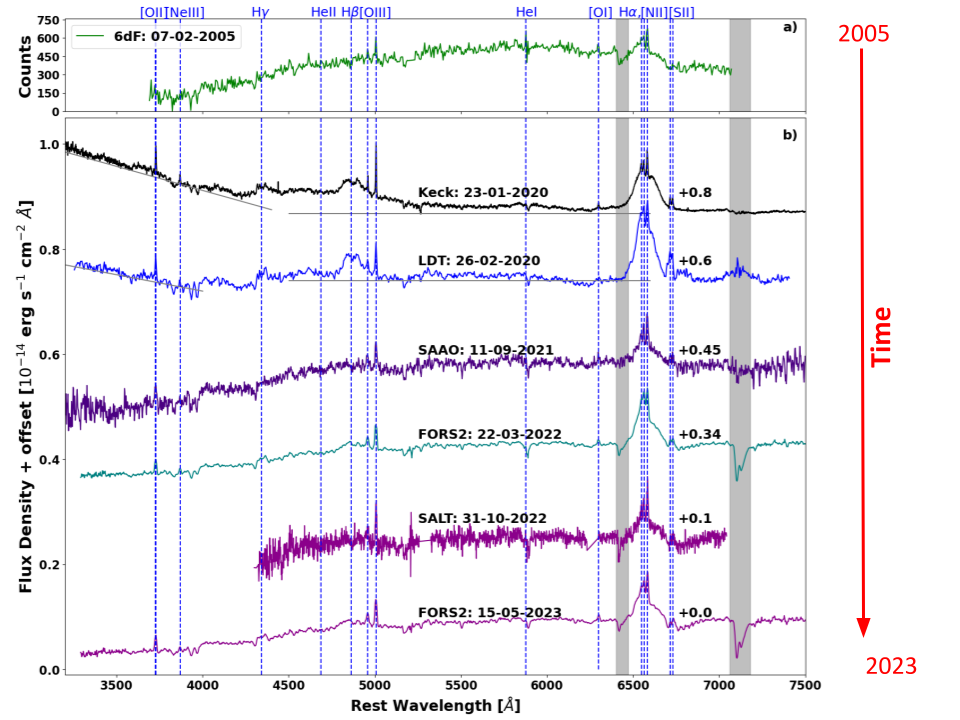
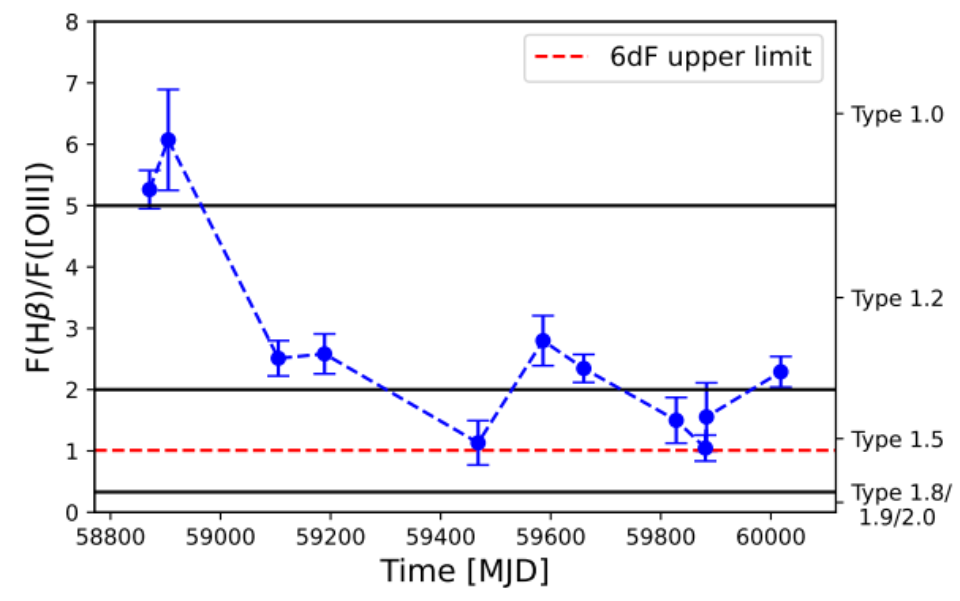
I have worked closely with the Close AGN Reference Survey (CARS) and the eROSITA collaboration to investigate the long-term spectral variability of changing-look AGNs (CLAGNs), including the well-studied CLAGN Mrk 1018 (Saha et al. 2025a), which exhibits characteristics similar to those observed in flaring black hole X-ray binaries. In collaboration with the eROSITA German collaboration, I have also undertaken multiwavelength follow-up campaigns of eROSITA-detected supermassive black hole transients, including CLAGNs and tidal disruption events, using XMM-Newton, SALT, and the VLT (Saha et al. 2025b; Markowitz et al. 2026, 2024; Homan et al. 2023; Krishnan et al. 2024). These studies include short-timescale changing-look AGNs exhibiting flaring activity or intensity dips over periods of a few months, as well as tidal disruption events occurring in already active galaxies. These sources can display dramatic changes in broad emission lines, particularly the Balmer lines and He II, indicating substantial changes in their ionising continua and, in some cases, their apparent Seyfert classification e.g. Type 1 to/from Type 1.8/1.9/2 (Fig. 1). Interestingly, these transient sources exhibit a dichotomy in their characteristic variability timescales: some vary over decades, while others evolve over only a few months. A key question is whether these different timescales can be understood in terms of accretion-disk instabilities and whether similar physical processes operate across black holes of different masses.
Furthermore, I greatly enjoy working closely with students and mentoring them on a range of AGN-based projects. I focus on developing their understanding of accretion onto compact objects, radiative processes in accreting systems, advanced statistical methods, mission-specific X-ray data reduction techniques (XMM-Newton, Chandra, NuSTAR, and eROSITA), and methodologies for X-ray data analysis.