Compact Objects in the Magellanic System
Stellar evolution in interacting galaxies
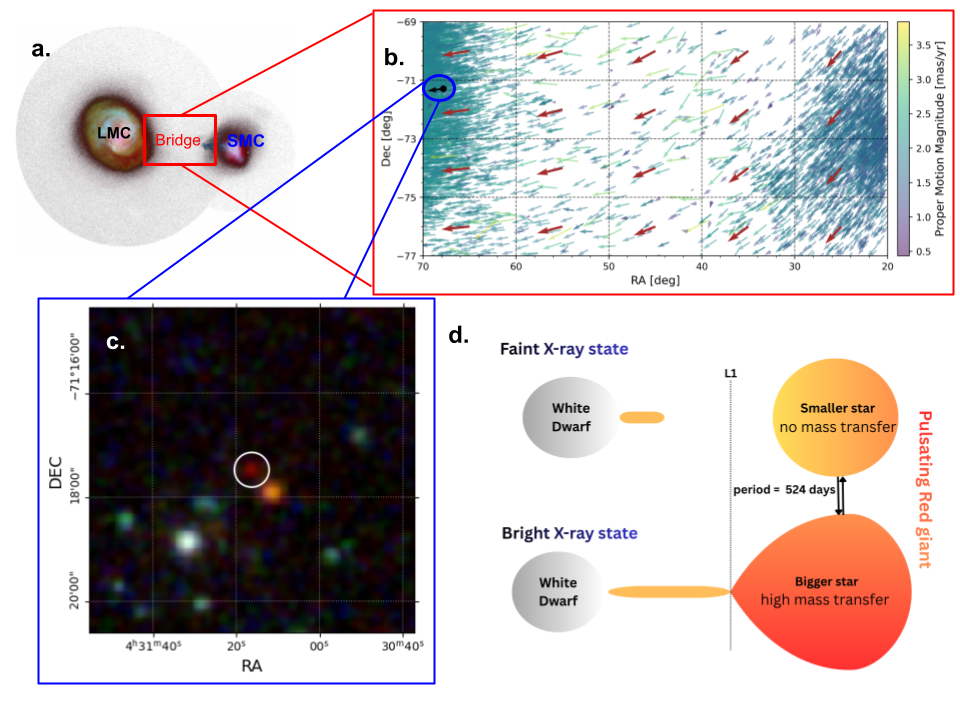
The Magellanic Clouds and the Magellanic Bridge provide a unique template for studying X-ray binary populations at known distances and sub-solar metallicities. I am a member of the eROSITA German Consortium and work closely with the Compact Objects Working group to identify and characterise the endpoints of stellar evolution — neutron stars, white dwarfs, and black holes — in binary systems using eROSITA all-sky survey (eRASS) data. I combine X-ray spectral analysis with multiwavelength observations, including optical spectroscopy, long-term optical/IR photometry, and kinematic data from Gaia, to identify and classify optical counterparts. My current work focuses on compact-object-powered X-ray sources in the Magellanic Bridge, including symbiotic X-ray binaries (Saha et al. 2026, Fig. 2), low-mass X-ray binaries, and super-soft sources. Using a continuous time-domain approach, I aim to build a more complete census of X-ray binaries in the Magellanic Bridge and use these systems to trace the history of stellar evolution in a dynamic environment shaped by the tidal interaction between the LMC and SMC. Classifying X-ray sources in crowded fields requires robust probabilistic cross-matching of X-ray catalogues with multiwavelength surveys. I develop and apply positional cross-matching pipelines and isochrone-based photometric classification methods to distinguish compact-object populations in the Local Group from background AGNs and foreground stars.